
There are a lot of different leagues around the professional soccer world and that means almost as many different formats, countless stories & intriguing histories from the last ~130 years of the beautiful game.
Most soccer fans in the US have been exposed to professional soccer in three ways:
Big 5 Euro Leagues Domestic & Continental competitions (Champions Leagues, etc.)
World Cup & Euro International competitions
MLS competitions (maybe some CONCACAF stuff here)
So—in the interest of exposing more fans to more leagues, styles & wacky ways for deciding who gets to raise trophies at the end of the season—welcome to our newest soccer-centric series, “SOCCER 210”.
There are 211 worldwide member associations in FIFA, with 210 first-division football leagues under that umbrella. Every week we’re going to dive into one of those 210 leagues, in one of those 211 associations, and learn about how the league works, a little bit of historical perspective and whatever other facts we find fun.
We won’t dive in too deep right off the bat—so first up is the top league from the country that hosted & won the first ever World Cup…
We head to South America & the Asociación Uruguaya de Fútbol‘s Liga Profesional de Primera División (known for sponsorship purposes as the “Torneo Uruguayo Copa Coca-Cola”) aka Uruguayan Primera División or Liga AUF Uruguaya.
REGULAR SEASON & CHAMPIONSHIP FORMAT HISTORY
Like most leagues around the world the format of the top division format in Uruguay has shifted many times over the years:
1900-68, ‘72-‘93: Double Round Robin
1969-71: Double Round Robin + added 6-team Championship Round (points carry over from regular season to championship round)
1994-2000: Competition is first divided into two stages, the Torneo Apertura (“Opening Championship”) & the Torneo Clausura (“Closing Championship”), with a two-legged final contested by the winners of the two stages. (In cases with a team winning both a final wasn’t played.)
2001-2002, 2004: The Torneo Clasifactorio (“Qualification Tournament”) was played at the beginning of the season to decide qualification for the two regular season stages.
2003: The Clasifactorio was abolished and the first instance of a multi-stage Championship Playoff was debuted: In addition to a two-legged playoff between Apertura & Clausura winners, the winner of that semifinal match will now face-off against the points leader from the aggregate season table (Aperture & Clausura tables combined). [This marks the first time since 1971 that more than two teams were, potentially, included in any type of post-season play]
2005: In an effort to stem the tide of players leaving mid-season Uruguay begins the shift from playing February-through-November to matching the European schedule of playing August-through-May. A special season was played in Spring ‘05, called the “Torneo Uruguay Especial”. The format was simplified back to a double round robin.
2005/06-15/16: We’re back to that 2003 format, except with a scheduling change—just to refresh, it’s now: Apertura in the Fall, Clausura in the Spring. Championship Semifinal (if needed) between stage champs. Championship final (if needed) between Semifinal winners vs. Aggregate League Table Leader.
2016: After the switch over the previous decade failed to fix the transfer issues (*cough cough*) ANOTHER special season was held in the Fall of 2016 as Uruguay decided to switch back to the February-through-November format they played in the first 100+ years.
2017-NOW: Now back to their original schedule starting in February there are *still* a couple tweaks to the format:
In between the Apertura & Clausura is now the Torneo Intermedio: a mid-season round-robin, with two groups split by their finish in the Apertura standings—Group A finished odd, Group B finished even.
Winners of the two groups play each other in a final (whose winner is now involved in a preseason Uruguayan Super Cup vs. the league title holders) and the points/results from the round-robin are included into the aggregate league table.
Since the original format’s uninterrupted 68-year run Uruguay is currently rolling into the 21st season with what is now its second-most used format. Including the debut of the two-stage championship playoff in 2003 and last year’s 2024 champions, there have been 20 seasons (and titles awarded) played with this format. In only SEVEN (35%) were both championship rounds played—in two of those seasons no playoff was played at all—and only ONCE did three different teams contest the playoffs.
Coming from the American perspective, it seems off to stick with a system that deprives you of the build-up and narrative (and money) that comes with a championship game. Not to mention one that has failed to include as many teams/markets as possible (Just look at what MLB did—again for money).
But as we’re about to learn, there hasn’t been much chance for championship narratives in Uruguayan history…
Competition or Complacency?
In 2025, Uruguay will see its 122nd season of first division football in the country since 1900.
Across the previous 121 championships, 101 of them have been won by TWO clubs; Peñarol (& their predecessor club C.U.R.C.C) have won FIFTY-TWO, with Nacional winning FORTY-NINE.
The other twenty titles have been spread out across nine other clubs. Not a single one of those clubs were able to win consecutive titles, something the two power clubs have done dozens of times.
In those 121 seasons one of Nacional or Peñarol/CURCC has finished in the Top 3 every single time—and in the overwhelming majority of those seasons (80%, 96/121) they combined to represent 2/3 of the Top 3.
The two-club-league’s parity has fluctuated slightly over the years and the Top 3/5 finishes over the last decade have featured more clubs than ever before—almost a third (8/25) of the seasons where either Nacional or Peñarol missed the Top 3 has occurred in the last 14 seasons—but the championship run for the top two teams has returned (10 of the last 11).
There was a stretch from ‘87-91 that didn’t see either power team take home the title, but in the following 34 seasons they traded the title between them 29 times. (And there’s the straight stretch from ‘30-75 in which the two clubs won every single title.)
In other words, Peñarol & National have dominated for 120 years and it doesn’t look like there’s any reason to expect an upstart to change the status quo.
BUT, if that would happen, everything tells us the challenge wouldn’t come from very far away.
Because that stark difference in prosperity has another layer.
Take a look at this graphic showing the location of all the teams in the top three divisions of the Uruguayan Football Association:
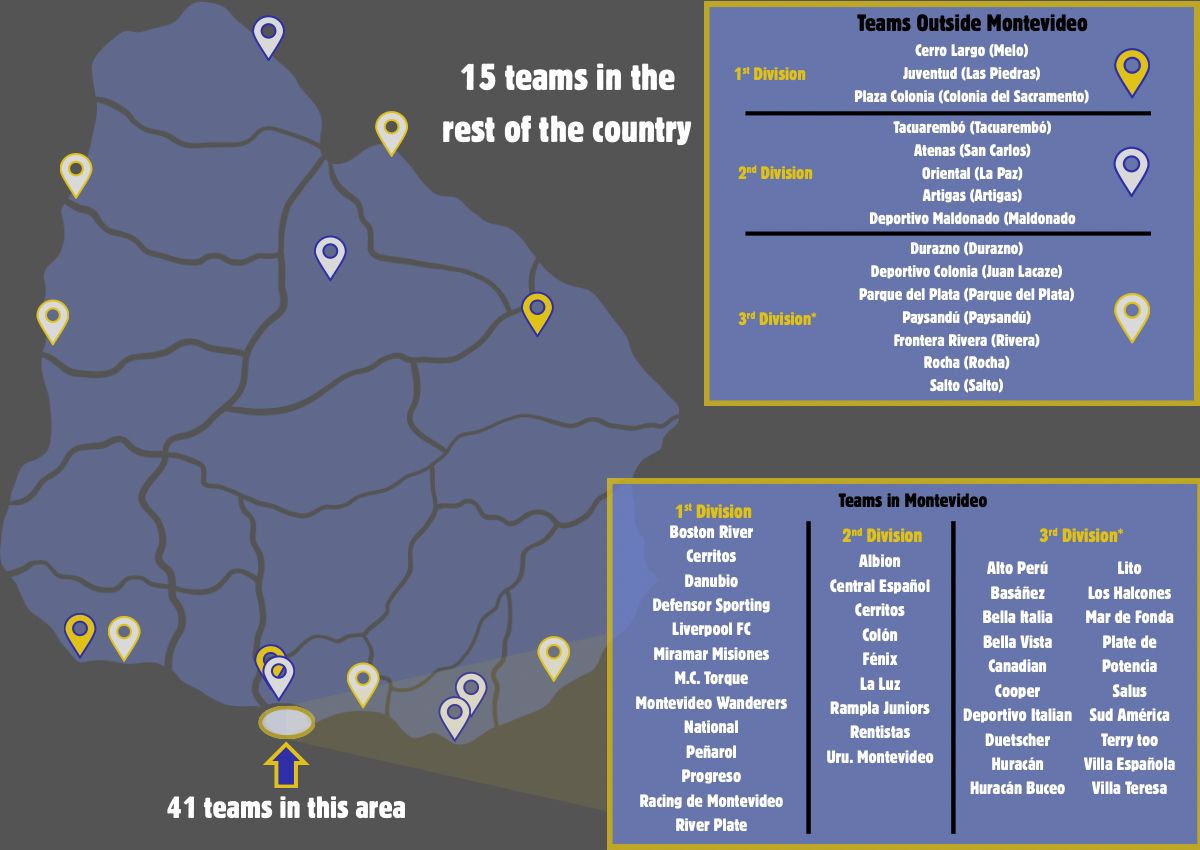
*3rd division is semi-pro
Montevideo is the capital and, at 1.3+ million in population, has around 38.3% of the country’s total population (3.39 million).
But when it comes to the top division in futbol the capital area has 13/16 spots, or 81.3% of the league. At the lower levels the numbers sit at 9/14 (64.3%) at the second level of the pyramid and 17/24 (70.1%) at the third.
That disparity has been acknowledged by the FA. The “Torneo Clasifactorio” from the early-2000s was broken up into three groups: One with seven teams, a second with six teams and a third with five teams. For the 2001 & 02 editions the first two groups were pulled only from Montevideo, whereas the third group was pulled from the teams outside of the capital. This meant they had a fighting chance and guaranteed a couple of spots to smaller clubs. In the ‘04 version there was a different set of rules but still drew a line between the groups.
(It also needs to be noted that this kind of disparity is not rare in world football. You’ll see.)
Salary comparisons across leagues in South America are tough to find. All agree that Brazil & Argentina are in tiers of their own. Most lists put the average Uruguayan 1st Division salary below fellow South American leagues like Chile, Columbia & Peru. That hasn’t stopped the country from contributing talent at a national level; Uruguay’s global transfer value for the national squad ranks #3 in CONMEBOL—and this time they’re at least in shouting distance of #2 Argentina.
Continental competitions are another way to look at this: A Uruguayan squad last played in a the final of the Copa Libertadores in 2011 and haven’t lifted a continental trophy since back-to-back wins in 1987 & 88. (Take a wild guess which two teams pulled off the feat)
Perspective is the whole point of this exercise—did you expect to see this much variety and change within a country that hosted the first World Cup?
Championship rounds & playoffs aren’t the first thing that comes to mind for leagues outside the MLS but their popularity outside of the biggest leagues in Europe brings us to a question that fans love to toss around: is a league table top finish the proper way to award a title in soccer? Hell—are playoffs even inherently American in this sport, like so many across the pond love to claim?
In this specific case the Uruguayan’s have given us a topical example as the MLS contemplates switching their schedule to match the European. The initial logic for both leagues is similar—match the windows—but the economic difference between Uruguay & the MLS completely changed the potential impact. Higher salaries in the US will help keep younger talent longer and rich clubs can leverage bigger price tags on those young players when they eventually do sell. Uruguay’s move was primary about retaining talent. The MLS’ goal is about convenience and scheduling. And, let’s be honest, a nice chunk of European Big 5 conformity.
As an MLS fan, do you want the league to switch from a February-to-November schedule to a match better with the transfer windows & international breaks of the August-to-May Euro schedule?
And where do you stand on deciding champions? Playoffs or league table finish?
Answer both questions in the comments and/or join in the conversation over on X @RoccSTL